
by DavidFraser | Feb 24, 2015 | Leadership, Relationship Skills, Systems
I don’t mean are you causing the problem: I mean are you engaged with it; or engaged with the people who are dealing with it? If not, you probably won’t have much impact. If you’re dissociated from the problem or the people, chances are you...

by DavidFraser | Aug 29, 2014 | Change, Leadership, Organizations, Systems
One philosophy of change in organisations starts from an assumption that structures, processes and systems are largely fixed at the outset—frozen, if you like. The approach then is to unfreeze the existing set-up, change it as required, developing whatever new...
by DavidFraser | May 23, 2014 | Change, Leadership, Organizations, Systems
Which is the best way of running organisations? Answer: Neither. We need both, if we want the best results and an engaged team. Top-down for direction and accountability, bottom-up for energy and resilience and adaptability. We need to keep the two in equilibrium, and...
by DavidFraser | Mar 21, 2014 | Change, Leadership, Systems
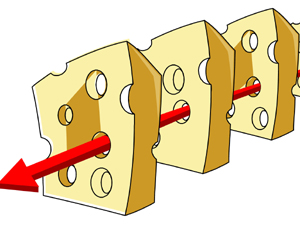
The Swiss cheese model is central to thinking about systemic failure. The idea is that each potential factor, which, when combined, could create a condition in which an accident could occur, is like a slice of a Swiss cheese with holes in it. All the factors are...
by DavidFraser | Mar 14, 2014 | Change, Leadership, Organizations, Systems
Inertia is usually better resourced than change—better staffed, better financed, and better organised. It’s usually easier to get paid to do something that reinforces the status quo than it is to do the radical work needed for an overhaul of the existing order....

by DavidFraser | Mar 7, 2014 | Change, Leadership, Organizations, Systems
W. Edwards Deming said “Help must come from outside because a system is not capable of understanding itself.” In other words, it can be hard to see the wood for the trees. This is true whether we’re talking about a single person or an organisation...
